Stored diesel
Fuel care starts in the tank.
Water and particles can build up while diesel sits in storage. Routine fuel sampling and maintenance help you understand its condition before the generator needs to run.
Explore fuel care

Stored diesel circulates from the tank into the fuel maintenance system.
Water separation and particle filtration help manage contamination.
Treated fuel returns to the tank. Controls and schedules vary by model.
INSIDE THE FUEL CARE LOOP
Explore how stored fuel care fits into your generator setup.
Hover, focus, or tap a gold marker to take a closer look.
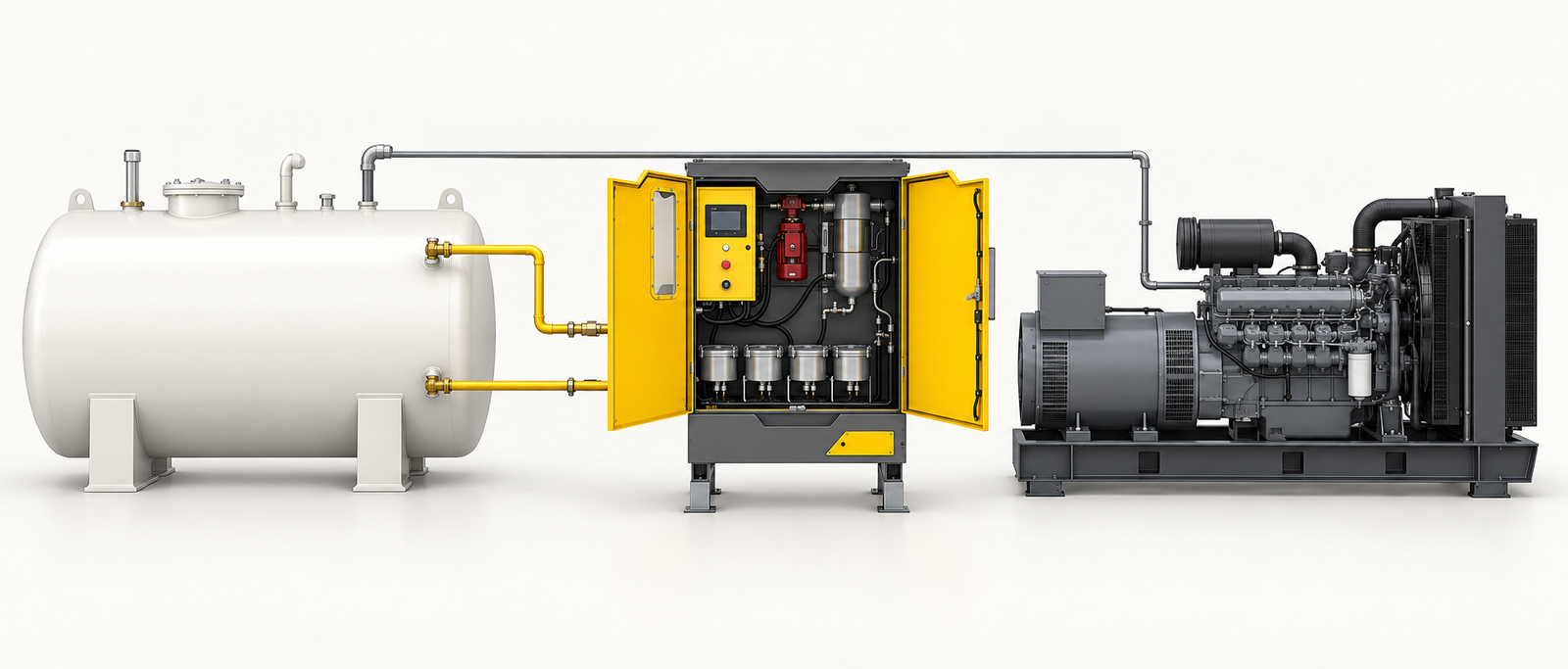
Select a marker to explore the role of each component.
Stored diesel
Water and particles can build up while diesel sits in storage. Routine fuel sampling and maintenance help you understand its condition before the generator needs to run.
Explore fuel careSystem controls
L series systems offer a 7 inch touchscreen and Modbus/IP communications. Discuss scheduling, monitoring, and building management integration for your facility.
Compare system controlsWater separation
Water separation helps reduce water related corrosion and conditions that support microbial growth. Separator design and automatic drain features vary by model.
Compare filtration featuresParticle filtration
Depth filtration captures particles that can clog filters and contribute to abrasive wear in pumps and injectors. The L series has a published particle removal rating down to 1 micron.
Explore the equipmentFuel return
Fuel polishing circulates fuel through treatment equipment and back to the tank. Tank connections, piping, and the operating schedule are planned around your installation.
Plan your installationGenerator readiness
Managing stored fuel contamination supports your wider generator maintenance plan. AFFS helps you choose equipment and guides you through the next steps with a local installation vendor.
Talk with JorgeConceptual illustration of fuel care equipment. Equipment, piping, and features vary by model and installation; the tank and generator are shown for context.
Why it matters
Water, sediment, and fine particles can affect filters and sensitive fuel system components. Fuel care helps address those risks.
Help reduce the dirt and sediment reaching your generator’s filters.
Removing water helps reduce corrosion and conditions that support microbial growth.
Fine particle filtration helps reduce abrasive wear in pumps and injectors.
Automated systems make routine treatment part of your maintenance plan.
Fuel care, explained
See how stored fuel contamination develops and how routine treatment helps manage it.
A filtration system is one part of your maintenance program. Keep following manufacturer guidance for inspections, sampling, filter changes, and tank cleaning when needed.
Filtration cannot reverse chemical degradation or guarantee that a generator will never fail.
Watch on YouTubeMake an informed choice
Diesel can collect water and particles while it sits in a tank. Contamination can clog filters, encourage corrosion, and affect pumps and injectors. Regular fuel care helps address those risks before the generator is called on.
It circulates diesel from the tank through treatment equipment and returns it to the tank. Water separation and particle filtration help manage contamination in the stored fuel. Controls and treatment features vary by model.
Managing contamination can help reduce clogged filters, corrosion caused by water, and abrasive wear in fuel system components. Removing water also reduces conditions that support microbial growth. Fuel care helps reduce trouble caused by contaminated fuel, while regular generator maintenance remains essential.
Fuel filtration is one part of your maintenance program. Keep following the generator and fuel system manufacturers’ guidance for inspections, fuel sampling, servicing, and tank cleaning when needed. Filtration cannot restore fuel that has chemically degraded.
A clearer next step
From your first question through installation, we’re with you every step.